Copy Bench method
Copy Bench scores how close a model's rebuild of a web component gets to the original when all it has is a few seconds of screen recording. Every model copies 50 components twice, first blind and then with a browser, and two judges from different labs grade each copy.
How it works
The tasks
50 hard components no model recognized: WebGL, shaders, animations and small games.
What models get
A 4–8 second recording and a tool to pull frames from it.[1]

The models
Each runs in its maker's own agent: Codex, Claude Code, Gemini CLI and so on.
One-shot, 30 min
There's no browser in the sandbox, so the model copies blind.
Self-verified, 20 min
Same session, now with a browser to check and fix the copy.[2]
Scoring
GPT-6.1 Sol and Claude Opus 5.5 grade every copy, and we average them.
What the judges see
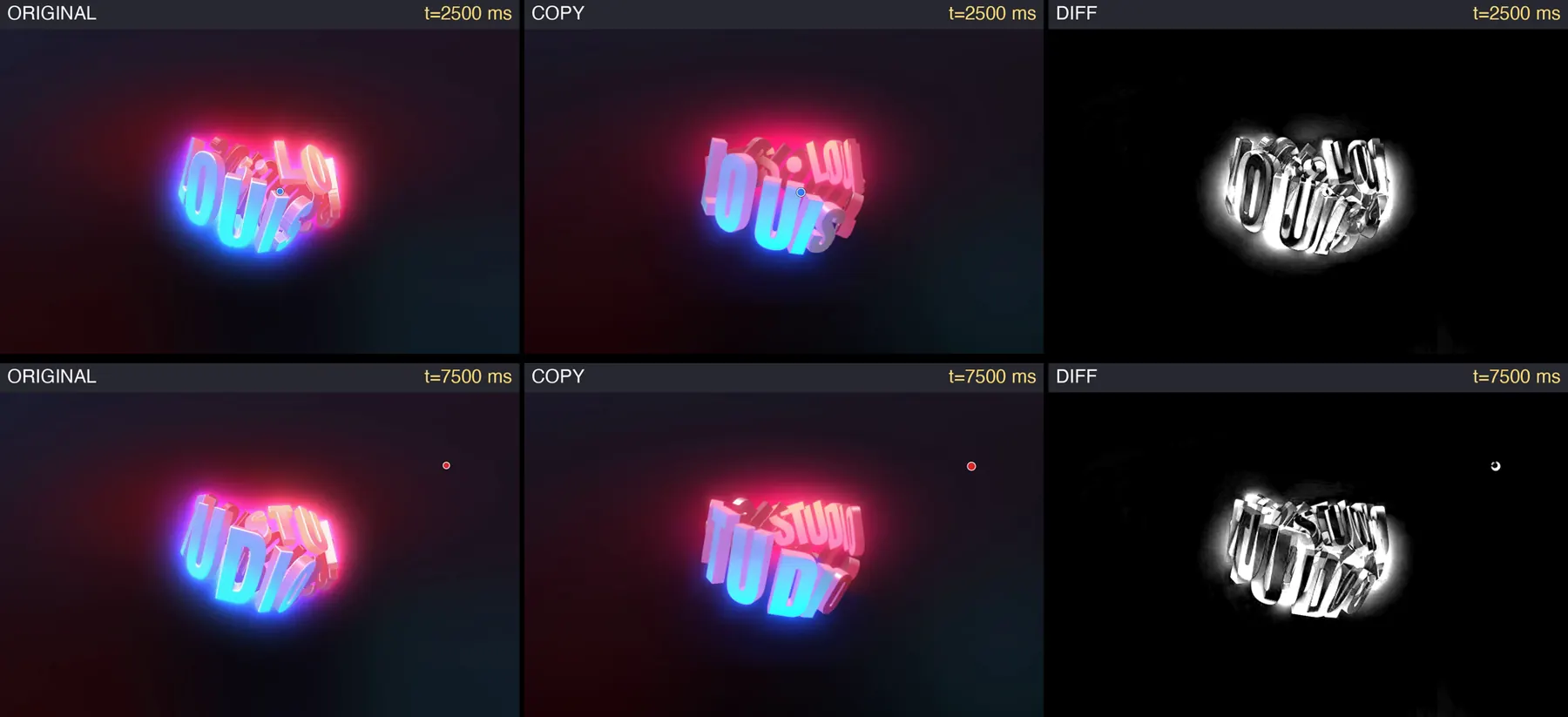
Original, copy and a diff side by side: the settled page, frames at four moments and the whole timeline. The copy can shift up to 120 ms to line up in time.
From checklist to score
26 checks in five groups, each answered same, minor or major. Code does the math: a group starts at 100 and loses 15 per minor, 40 per major.
Three looks before a major counts
Any major gets a second look. If the two disagree on a major, a third look breaks the tie, check by check. GPT-6.1 Sol grades each copy three times and we keep the median; Opus looks once.
How much to trust it
Each judge agrees with itself at 0.95 or better and with the other at 0.85, and their average matches 249 hand-scored copies at 0.84.
What scores zero
Pasted code, loading the original, faked motion (a video or flipped frames) and no file.
Limits
Judge bias
The GPT judge gives GPT models about 4 points more than Claude does, and averaging judges from two labs halves that.
Rerun noise
A rerun can move one task 10 to 19 points, so single-task gaps mean little.
Hand scoring
One person did the hand scoring, on 23 of the 50 components, and saw the GPT judge's score first.
WebGL in the public tasks
The reference recordings were made on macOS with GPU rendering. In a Linux sandbox Chromium draws WebGL and shaders in software, so a correct WebGL copy can look a little different from the reference. Our published results were captured on the same machine for both sides, so they don't have this problem.
Data and code
13 of the 50 tasks are public on GitHub. They run on Valkyrie as copy-bench/copy-bench@v1. The other 37 stay private so the benchmark stays useful.
Notes
- [1]
We tried other inputs on Claude Opus 5.5 and Sonnet 5.5:
- Screenshot: motion scored 5 or less out of 100 on 83% of 136 copies. The ones that got motion right worked from memory. On Magic UI's animated list, the agent wrote: "The screenshot looks like Magic UI's animated-list demo, so I matched it to that."
- Same frames (2 per second) without the mp4: Sonnet 62.5 vs 49 with it, Opus 54 vs 49. That's within run-to-run noise, so the mp4 itself adds nothing.
- Live URL: the model pasted the original's own code in 34 of 68 copies.
- [2]
The browser is agent-browser. 153 of 1,400 steps hit the time limit; they're scored on whatever file was there.