"use client";

import { type MouseEvent } from "react";
import { Toc, TocList, TocItem, TocLink } from "@/components/ui/toc";

const HEADINGS = [
  {
    id: "toc-nested-install",
    title: "Installation",
    depth: 2,
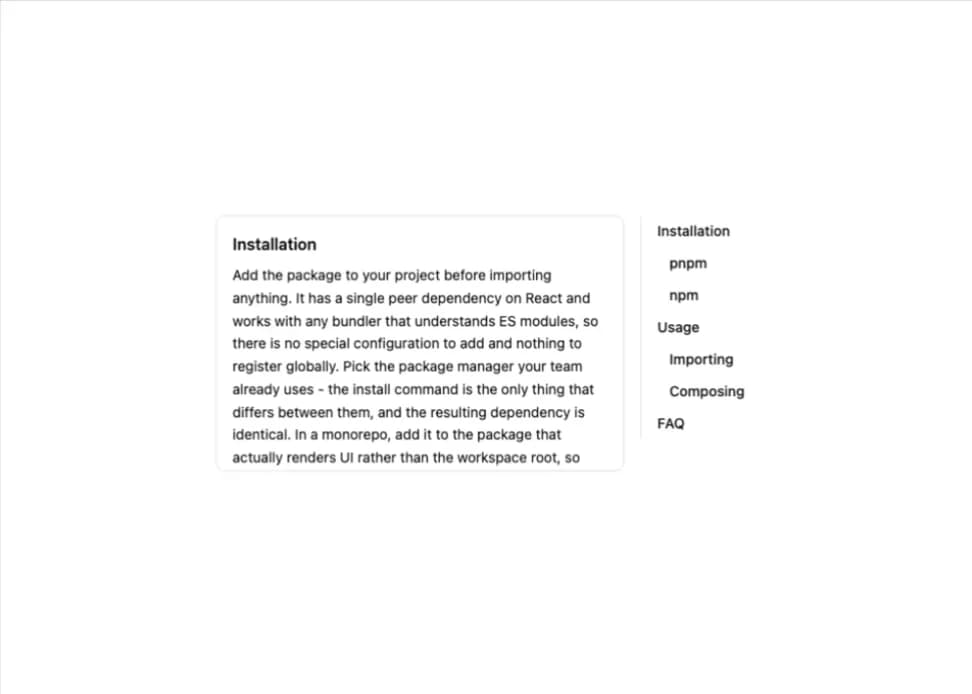
    body: "Add the package to your project before importing anything. It has a single peer dependency on React and works with any bundler that understands ES modules, so there is no special configuration to add and nothing to register globally. Pick the package manager your team already uses - the install command is the only thing that differs between them, and the resulting dependency is identical. In a monorepo, add it to the package that actually renders UI rather than the workspace root, so each app pins the version it depends on and upgrades stay scoped. Commit your lockfile afterwards so every environment, including CI, resolves exactly the same build of the library. Once it is installed you can import any component from its own subpath and start composing immediately, with no build step and no global stylesheet to wire up first.",
  },
  {
    id: "toc-nested-pnpm",
    title: "pnpm",
    depth: 3,
    body: "Run pnpm add to install it into the current workspace. In a monorepo, scope it to the package that renders UI rather than the root so versions stay explicit per app.",
  },
  {
    id: "toc-nested-npm",
    title: "npm",
    depth: 3,
    body: "npm install works identically and writes the dependency to your package.json. Commit the lockfile so every environment resolves the same version of the library.",
  },
  {
    id: "toc-nested-usage",
    title: "Usage",
    depth: 2,
    body: "Import the parts you need and compose them. Components are designed to be assembled rather than configured through long prop lists, so most screens are just JSX. The pieces share a styling context, so a variant set once flows down.",
  },
  {
    id: "toc-nested-import",
    title: "Importing",
    depth: 3,
    body: "Each component lives at its own subpath, so import from there rather than a barrel. This keeps your bundle lean and makes it obvious which parts a file actually depends on.",
  },
  {
    id: "toc-nested-compose",
    title: "Composing",
    depth: 3,
    body: "Nest the sub-components to build the shape you want, and reach for the render prop when you need to project a part onto your own element. Composition is the primary extension point across the whole library.",
  },
  {
    id: "toc-nested-faq",
    title: "FAQ",
    depth: 2,
    body: "Answers to the questions that come up most often, from server-component support to bundle size and theming. If something is missing here, the per-component pages go deeper.",
  },
];

// Demo only: scrolls within this panel instead of the page so the example stays put.
// A page-level TOC needs none of this - let the anchor jump the page natively.
function scrollWithinPanel(event: MouseEvent<HTMLElement>) {
  const link = (event.target as HTMLElement).closest('a[href^="#"]');
  if (!link) return;
  const id = decodeURIComponent(link.getAttribute("href")!.slice(1));
  const heading = document.getElementById(id);
  const panel = heading?.closest("[data-scroll-panel]");
  if (!heading || !panel) return;
  event.preventDefault();
  const gap = parseFloat(getComputedStyle(heading).scrollMarginTop) || 0;
  const top =
    heading.getBoundingClientRect().top -
    panel.getBoundingClientRect().top +
    panel.scrollTop -
    gap;
  panel.scrollTo({ top, behavior: "smooth" });
}

export default function TocNested() {
  return (
    <div className="flex w-full max-w-xl gap-4">
      <div
        data-scroll-panel
        className="border-border h-64 flex-1 scrollbar-none overflow-auto rounded-lg border p-4"
      >
        {HEADINGS.map((heading) => (
          <section key={heading.id} className="mb-6 last:mb-0">
            {heading.depth === 2 ? (
              <h3
                id={heading.id}
                className="text-foreground-intense mb-2 scroll-mt-6 font-semibold"
              >
                {heading.title}
              </h3>
            ) : (
              <h4
                id={heading.id}
                className="text-foreground-intense mb-2 scroll-mt-6 text-sm font-medium"
              >
                {heading.title}
              </h4>
            )}
            <p className="text-sm leading-relaxed">{heading.body}</p>
          </section>
        ))}
      </div>

      <Toc className="w-38 shrink-0" onClick={scrollWithinPanel}>
        <TocList>
          {HEADINGS.map((heading) => (
            <TocItem key={heading.id}>
              <TocLink href={`#${heading.id}`} depth={heading.depth}>
                {heading.title}
              </TocLink>
            </TocItem>
          ))}
        </TocList>
      </Toc>
    </div>
  );
}