
About
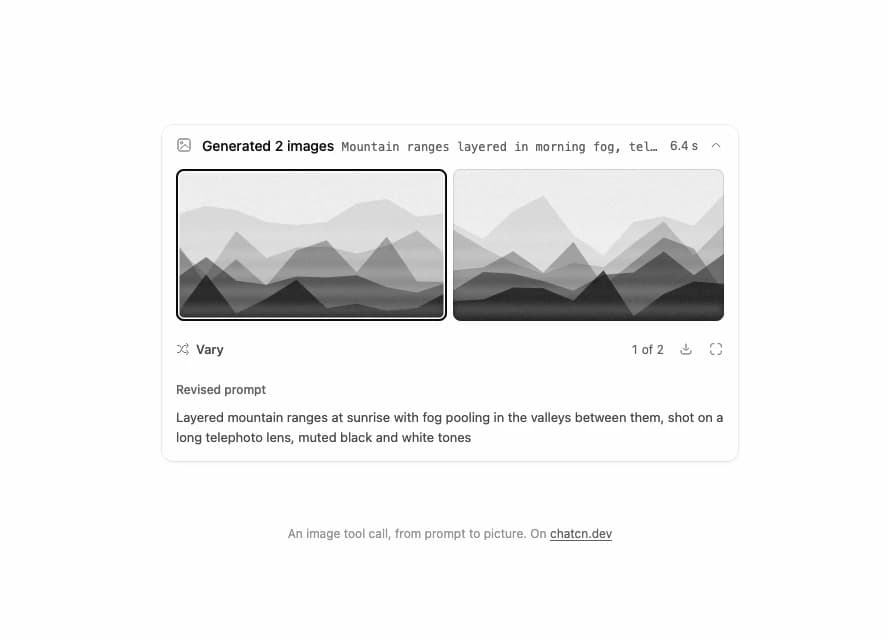
An image generation tool call in the thread: the prompt, images that sharpen as they render with progress and time left, then the results with the revised prompt, Vary, download and full screen.
Built with React and Tailwind. Copy the prompt and paste it into Claude Code, Cursor or Lovable: your agent adds Tool Image Gen to your project and fits it to your theme.
Code
How Tool Image Gen is used: the demo's code. The component's own source comes with a free account.
Usage.tsx
"use client"

import * as React from "react"
import { ToolDisplayState, ToolImageGen } from "@/components/ui/tool-image-gen"

const FIT_CSS = "html,body{overflow:hidden}[data-fit-small] [data-fit-hide]{display:none!important}"

/**
 * 21st shows a demo in a small frame: about 674 by 421 on a component page, 358 by 224 on a
 * phone and 245 by 139 on a profile card. A demo taller than its frame gets scrollbars, which
 * render white on dark pages. FitFrame fills the frame exactly instead.
 *
 * - "scale": the content shrinks until it fits, centered. For visuals such as orbs.
 * - "crop": the content stays at full size from the top and fades out at the bottom. For text
 *   that streams in, where a changing scale would make the page breathe.
 *
 * `minWidth` lays out a wide demo (a table, a two column panel) at that width and scales it down
 * to the frame, instead of letting it collapse to a narrow layout. The frame centers it, so it
 * shrinks evenly on both sides.
 *
 * Anything marked `data-fit-hide` (state buttons, the chatcn.dev line) drops out in frames
 * shorter than `hideBelow`, so a profile card shows the visual alone.
 */
function FitFrame({
  children,
  mode = "scale",
  hideBelow = 360,
  minWidth,
}: {
  children: React.ReactNode
  mode?: "scale" | "crop"
  hideBelow?: number
  minWidth?: string
}) {
  const content = React.useRef<HTMLDivElement>(null)
  const [cropped, setCropped] = React.useState(false)

  React.useLayoutEffect(() => {
    const el = content.current
    if (!el) return
    const measure = () => {
      const vw = window.innerWidth
      const vh = window.innerHeight
      el.toggleAttribute("data-fit-small", vh < hideBelow)
      // Layout sizes ignore the transform, so measuring never feeds back.
      const w = Math.max(el.offsetWidth, el.scrollWidth)
      const h = Math.max(el.offsetHeight, el.scrollHeight)
      const scale = mode === "scale" ? Math.min(1, vw / w, vh / h) : 1
      el.style.transform = scale < 1 ? `scale(${scale})` : ""
      setCropped(mode === "crop" && h > vh + 1)
    }
    measure()
    const observer = new ResizeObserver(measure)
    observer.observe(el)
    // Content that changes inside a fixed width box (a headline that cycles words) never resizes
    // the box itself, so changes below it measure again on the next frame.
    let frame = 0
    const mutations = new MutationObserver(() => {
      cancelAnimationFrame(frame)
      frame = requestAnimationFrame(measure)
    })
    mutations.observe(el, { subtree: true, childList: true, characterData: true })
    window.addEventListener("resize", measure)
    return () => {
      observer.disconnect()
      mutations.disconnect()
      cancelAnimationFrame(frame)
      window.removeEventListener("resize", measure)
    }
  }, [mode, hideBelow])

  const fade = "linear-gradient(to bottom, #000 calc(100% - 40px), transparent)"
  return (
    <div
      className="flex w-full justify-center overflow-hidden"
      style={{
        height: "100dvh",
        alignItems: mode === "crop" ? "flex-start" : "center",
        maskImage: cropped ? fade : undefined,
        WebkitMaskImage: cropped ? fade : undefined,
      }}
    >
      <style>{FIT_CSS}</style>
      <div
        ref={content}
        className="w-full shrink-0"
        style={{ transformOrigin: mode === "crop" ? "top center" : "center", minWidth }}
      >
        {children}
      </div>
    </div>
  )
}

interface JobOptions {
  /** Queue positions to step through before generating. Empty skips the queue. */
  queue?: number[]
  queueStepMs?: number
  /** Time from 0 to 100 percent. */
  durationMs?: number
  /** Where the job ends. Default "done". */
  outcome?: "done" | "failed" | "blocked"
  /** Percent at which a failed or blocked job stops. */
  stopAt?: number
  /** Start on mount. Default true. */
  autoStart?: boolean
}

type JobStatus = "queued" | "generating" | "done" | "failed" | "blocked"

/** Small seeded PRNG (mulberry32): same seed, same picture. */
function random(seed: number) {
  let a = seed >>> 0
  return () => {
    a = (a + 0x6d2b79f5) >>> 0
    let t = a
    t = Math.imul(t ^ (t >>> 15), t | 1)
    t ^= t + Math.imul(t ^ (t >>> 7), t | 61)
    return ((t ^ (t >>> 14)) >>> 0) / 4294967296
  }
}

/**
 * A scripted generation job for demos: walks the queue, then reports progress in uneven steps
 * every 240 ms, the way real providers do, and lands on the outcome. `run()` starts it again.
 */
function useGenerationJob({
  queue = [2, 1],
  queueStepMs = 900,
  durationMs = 5600,
  outcome = "done",
  stopAt = 46,
  autoStart = true,
}: JobOptions = {}) {
  const [state, setState] = React.useState<{
    status: JobStatus
    progress?: number
    queuePosition?: number
  }>({ status: "queued", queuePosition: queue[0] })
  const [runId, setRunId] = React.useState(autoStart ? 1 : 0)
  const options = React.useRef({ queue, queueStepMs, durationMs, outcome, stopAt })
  options.current = { queue, queueStepMs, durationMs, outcome, stopAt }

  React.useEffect(() => {
    if (runId === 0) return
    const { queue, queueStepMs, durationMs, outcome, stopAt } = options.current
    const timers: number[] = []
    const rand = random(runId * 31)
    const at = (ms: number, fn: () => void) => timers.push(window.setTimeout(fn, ms))
    setState({ status: "queued", queuePosition: queue[0] })
    queue.forEach((position, i) => {
      at(i * queueStepMs, () => setState({ status: "queued", queuePosition: position }))
    })
    const start = queue.length * queueStepMs
    at(start, () => setState({ status: "generating", progress: 0 }))
    const steps = Math.max(4, Math.round(durationMs / 240))
    let p = 0
    let t = start
    for (let i = 1; i <= steps; i++) {
      t += 240
      p = Math.min(100, p + (100 / steps) * (0.4 + rand() * 1.2))
      const value = i === steps ? 100 : Math.min(99, Math.round(p))
      if (outcome !== "done" && value >= stopAt) {
        at(t, () => setState({ status: outcome, progress: value }))
        break
      }
      at(t, () => setState({ status: "generating", progress: value }))
      if (i === steps) at(t + 280, () => setState({ status: "done", progress: 100 }))
    }
    return () => {
      for (const id of timers) window.clearTimeout(id)
    }
  }, [runId])

  const run = React.useCallback(() => setRunId((id) => id + 1), [])
  return { ...state, run }
}

type Scene = "dunes" | "peaks" | "sphere" | "ripples" | "stairs" | "moon"

/** Prompts that match each scene, written the way people prompt image models. */
const PROMPTS: Record<Scene, string> = {
  dunes:
    "Dune ridges at dusk, long raking shadows, medium format film, fine grain, black and white",
  peaks: "Mountain ranges layered in morning fog, telephoto compression, quiet, monochrome",
  sphere: "A matte sphere resting on a seamless studio sweep, single soft key light, monochrome",
  ripples: "Concentric ripples on black water, shot from above at night, high contrast",
  stairs: "Concrete stairs in hard noon light, deep diagonal shadows, black and white",
  moon: "A low moon over a calm sea, its reflection breaking into lines, long exposure",
}

const PROMPT = PROMPTS.peaks

interface SceneOptions {
  /** Seed for the shapes. Different seeds give different variations of one scene. */
  seed?: number
  /** Width over height. Default 1. */
  ratio?: number
  /** Long edge in px. Default 1200. */
  size?: number
}

const r1 = (n: number) => Math.round(n * 10) / 10

/** A smooth ridge line across the frame, closed down to the bottom edge. */
function ridge(
  w: number,
  h: number,
  base: number,
  amp: number,
  rand: () => number,
  jagged = false,
) {
  const steps = jagged ? 9 : 5
  const pts: [number, number][] = []
  for (let i = 0; i <= steps; i++) {
    const x = (i / steps) * w
    const y = base + (rand() - 0.5) * amp * (jagged && i % 2 ? 1.6 : 1)
    pts.push([x, y])
  }
  let d = `M0 ${h} L0 ${r1(pts[0]?.[1] ?? base)}`
  for (let i = 1; i < pts.length; i++) {
    const [x0, y0] = pts[i - 1] ?? [0, base]
    const [x1, y1] = pts[i] ?? [w, base]
    if (jagged) d += ` L${r1(x1)} ${r1(y1)}`
    else {
      const cx = (x0 + x1) / 2
      d += ` C${r1(cx)} ${r1(y0)} ${r1(cx)} ${r1(y1)} ${r1(x1)} ${r1(y1)}`
    }
  }
  return `${d} L${w} ${h} Z`
}

function grain(w: number, h: number, seed: number, opacity = 0.16) {
  return `<filter id="g" x="0" y="0" width="100%" height="100%"><feTurbulence type="fractalNoise" baseFrequency="0.85" numOctaves="2" seed="${seed}" stitchTiles="stitch"/><feColorMatrix type="saturate" values="0"/></filter><rect width="${w}" height="${h}" filter="url(#g)" opacity="${opacity}"/>`
}

function draw(scene: Scene, w: number, h: number, seed: number) {
  const rand = random(seed * 7919 + scene.length)
  const parts: string[] = []
  const m = Math.min(w, h)

  switch (scene) {
    case "dunes": {
      parts.push(`<rect width="${w}" height="${h}" fill="white"/>`)
      parts.push(`<rect width="${w}" height="${h}" fill="black" opacity="0.06"/>`)
      const sunX = w * (0.25 + rand() * 0.5)
      parts.push(`<circle cx="${r1(sunX)}" cy="${r1(h * 0.3)}" r="${r1(m * 0.07)}" fill="white"/>`)
      const layers = [0.1, 0.2, 0.34, 0.52, 0.72, 0.86]
      layers.forEach((alpha, i) => {
        const base = h * (0.42 + i * 0.1)
        parts.push(
          `<path d="${ridge(w, h, base, h * 0.12, rand)}" fill="black" opacity="${alpha}"/>`,
        )
      })
      break
    }
    case "peaks": {
      parts.push(`<rect width="${w}" height="${h}" fill="white"/>`)
      parts.push(`<rect width="${w}" height="${h}" fill="black" opacity="0.04"/>`)
      const layers = [0.08, 0.15, 0.26, 0.42, 0.66]
      layers.forEach((alpha, i) => {
        const base = h * (0.36 + i * 0.12)
        parts.push(
          `<path d="${ridge(w, h, base, h * 0.28, rand, true)}" fill="black" opacity="${alpha}"/>`,
        )
        // Fog banks between the ranges.
        parts.push(
          `<rect y="${r1(base + h * 0.06)}" width="${w}" height="${r1(h * 0.05)}" fill="white" opacity="0.35" filter="url(#b)"/>`,
        )
      })
      parts.unshift(
        `<filter id="b" x="-10%" y="-200%" width="120%" height="500%"><feGaussianBlur stdDeviation="${r1(m * 0.03)}"/></filter>`,
      )
      break
    }
    case "sphere": {
      const cx = w * (0.4 + rand() * 0.2)
      const r = m * (0.18 + rand() * 0.06)
      const floor = h * 0.68
      const cy = floor - r
      parts.push(
        `<defs><radialGradient id="bg" cx="50%" cy="38%" r="75%"><stop offset="0" stop-color="white"/><stop offset="1" stop-color="black" stop-opacity="0.9"/></radialGradient>`,
        `<radialGradient id="s" cx="34%" cy="30%" r="80%"><stop offset="0" stop-color="white"/><stop offset="0.55" stop-color="black" stop-opacity="0.55"/><stop offset="1" stop-color="black" stop-opacity="0.95"/></radialGradient>`,
        `<filter id="b" x="-50%" y="-200%" width="200%" height="500%"><feGaussianBlur stdDeviation="${r1(r * 0.18)}"/></filter></defs>`,
      )
      parts.push(`<rect width="${w}" height="${h}" fill="black"/>`)
      parts.push(`<rect width="${w}" height="${h}" fill="url(#bg)" opacity="0.92"/>`)
      parts.push(
        `<rect y="${r1(floor)}" width="${w}" height="${r1(h - floor)}" fill="black" opacity="0.18"/>`,
      )
      parts.push(
        `<ellipse cx="${r1(cx + r * 0.25)}" cy="${r1(floor + r * 0.04)}" rx="${r1(r * 1.25)}" ry="${r1(r * 0.16)}" fill="black" opacity="0.7" filter="url(#b)"/>`,
      )
      parts.push(`<circle cx="${r1(cx)}" cy="${r1(cy)}" r="${r1(r)}" fill="url(#s)"/>`)
      break
    }
    case "ripples": {
      parts.push(`<rect width="${w}" height="${h}" fill="black"/>`)
      parts.push(`<rect width="${w}" height="${h}" fill="white" opacity="0.06"/>`)
      const cx = w * (0.35 + rand() * 0.3)
      const cy = h * (0.45 + rand() * 0.15)
      const rings = 9 + Math.floor(rand() * 4)
      for (let i = rings; i > 0; i--) {
        const rx = (i / rings) * w * 0.75
        parts.push(
          `<ellipse cx="${r1(cx)}" cy="${r1(cy)}" rx="${r1(rx)}" ry="${r1(rx * 0.32)}" fill="none" stroke="white" stroke-width="${r1(1 + (rings - i) * 0.35)}" opacity="${r1((1 - i / rings) * 0.75 + 0.18)}"/>`,
        )
      }
      parts.push(
        `<ellipse cx="${r1(cx)}" cy="${r1(cy)}" rx="${r1(m * 0.012)}" ry="${r1(m * 0.005)}" fill="white" opacity="0.9"/>`,
      )
      break
    }
    case "stairs": {
      parts.push(`<rect width="${w}" height="${h}" fill="white"/>`)
      parts.push(`<rect width="${w}" height="${h}" fill="black" opacity="0.08"/>`)
      const n = 8 + Math.floor(rand() * 4)
      const sw = w / n
      const sh = (h * 0.78) / n
      const base = h * 0.98
      // Risers: the solid mass under the zigzag.
      let pts = `0,${h}`
      for (let i = 0; i < n; i++) {
        pts += ` ${r1(i * sw)},${r1(base - i * sh)} ${r1(i * sw)},${r1(base - (i + 1) * sh)} ${r1((i + 1) * sw)},${r1(base - (i + 1) * sh)}`
      }
      pts += ` ${w},${h}`
      parts.push(`<polygon points="${pts}" fill="black" opacity="0.5"/>`)
      // Treads catch the sun as thin bright strips.
      for (let i = 0; i < n; i++) {
        parts.push(
          `<rect x="${r1(i * sw)}" y="${r1(base - (i + 1) * sh)}" width="${r1(sw)}" height="${r1(sh * 0.22)}" fill="white" opacity="0.7"/>`,
        )
      }
      // Hand rail and balusters, parallel to the flight.
      const lift = sh * 2.6
      parts.push(
        `<line x1="0" y1="${r1(base - lift)}" x2="${w}" y2="${r1(base - n * sh - lift)}" stroke="black" stroke-width="${r1(m * 0.006)}" opacity="0.75"/>`,
      )
      for (let i = 0; i < n; i++) {
        const x = i * sw + sw * 0.5
        const y = base - (i + 1) * sh
        parts.push(
          `<line x1="${r1(x)}" y1="${r1(y)}" x2="${r1(x)}" y2="${r1(y - lift + sh * 0.5)}" stroke="black" stroke-width="${r1(m * 0.003)}" opacity="0.6"/>`,
        )
      }
      // A hard shadow wedge from the wall above.
      const s0 = w * (0.45 + rand() * 0.15)
      parts.push(
        `<polygon points="0,0 ${r1(s0)},0 ${r1(s0 - w * 0.5)},${h} 0,${h}" fill="black" opacity="0.28"/>`,
      )
      break
    }
    case "moon": {
      parts.push(`<rect width="${w}" height="${h}" fill="black"/>`)
      parts.push(`<rect width="${w}" height="${h}" fill="white" opacity="0.05"/>`)
      const cx = w * (0.3 + rand() * 0.4)
      const horizon = h * 0.6
      const r = m * 0.11
      parts.push(
        `<filter id="b" x="-100%" y="-100%" width="300%" height="300%"><feGaussianBlur stdDeviation="${r1(r * 0.5)}"/></filter>`,
      )
      parts.push(
        `<circle cx="${r1(cx)}" cy="${r1(h * 0.3)}" r="${r1(r * 1.5)}" fill="white" opacity="0.12" filter="url(#b)"/>`,
      )
      parts.push(
        `<circle cx="${r1(cx)}" cy="${r1(h * 0.3)}" r="${r1(r)}" fill="white" opacity="0.92"/>`,
      )
      parts.push(
        `<rect y="${r1(horizon)}" width="${w}" height="${r1(h - horizon)}" fill="white" opacity="0.04"/>`,
      )
      // The reflection breaks into short horizontal strokes.
      for (let i = 0; i < 26; i++) {
        const y = horizon + 6 + i * ((h - horizon) / 26)
        const len = r * (0.4 + rand() * 1.4) * (1 + i * 0.05)
        parts.push(
          `<rect x="${r1(cx - len / 2 + (rand() - 0.5) * r * 0.6)}" y="${r1(y)}" width="${r1(len)}" height="${r1(1.5 + i * 0.12)}" fill="white" opacity="${r1(0.75 - i * 0.025)}"/>`,
        )
      }
      break
    }
  }

  parts.push(grain(w, h, seed % 97, scene === "ripples" || scene === "moon" ? 0.22 : 0.16))
  return parts.join("")
}

/** One picture of a scene as an SVG data URL, plus its intrinsic size. */
function scene(kind: Scene, { seed = 1, ratio = 1, size = 1200 }: SceneOptions = {}) {
  const w = ratio >= 1 ? size : Math.round(size * ratio)
  const h = ratio >= 1 ? Math.round(size / ratio) : size
  const svg = `<svg xmlns="http://www.w3.org/2000/svg" width="${w}" height="${h}" viewBox="0 0 ${w} ${h}">${draw(kind, w, h, seed)}</svg>`
  return { src: `data:image/svg+xml;charset=utf-8,${encodeURIComponent(svg)}`, width: w, height: h }
}

const images = [1, 2].map((seed) => ({
  id: `peaks-${seed}`,
  ...scene("peaks", { seed, ratio: 16 / 9 }),
}))

/** The model writes the prompt, the tool renders two variations, then the call settles. */
function ToolImageGenDemo() {
  const [typed, setTyped] = React.useState(0)
  const job = useGenerationJob({ queue: [], durationMs: 5200, autoStart: false })
  const { run } = job

  React.useEffect(() => {
    if (typed >= PROMPT.length) {
      run()
      return
    }
    const id = window.setTimeout(() => setTyped((n) => Math.min(PROMPT.length, n + 4)), 40)
    return () => window.clearTimeout(id)
  }, [typed, run])

  const state: ToolDisplayState =
    typed < PROMPT.length
      ? "input-streaming"
      : job.status === "done"
        ? "output-available"
        : "input-available"

  return (
    <div className="w-full max-w-xl">
      <ToolImageGen
        state={state}
        prompt={PROMPT.slice(0, typed)}
        revisedPrompt="Layered mountain ranges at sunrise with fog pooling in the valleys between them, shot on a long telephoto lens, muted black and white tones"
        aspectRatio="16:9"
        count={2}
        progress={state === "input-available" ? job.progress : undefined}
        images={state === "input-streaming" ? [] : images}
        onVary={() => {}}
      />
    </div>
  )
}

/** The line under each 21st demo that points back to the kit. */
function MoreOn({ slug, children }: { slug: string; children: React.ReactNode }) {
  return (
    <p data-fit-hide className="text-[0.75rem]/[1rem] text-(color:--chatcn-fg-faint) text-center text-balance">
      {children}{" "}
      <a
        href={`https://chatcn.dev/docs/components/${slug}`}
        target="_blank"
        rel="noopener"
        className="text-(color:--chatcn-fg-subtle) hover:text-(color:--chatcn-fg) underline underline-offset-2"
      >
        chatcn.dev
      </a>
    </p>
  )
}

/** The kit's own example, framed for the 21st preview. */
export default function ToolImageGenPreview() {
  return (
    <FitFrame minWidth="36rem">
      <div className="flex w-full flex-col items-center justify-center gap-4 p-6">
        <div className="flex h-[24rem] w-full max-w-2xl items-start justify-center">
          <ToolImageGenDemo />
        </div>
        <MoreOn slug="tool-image-gen">An image tool call, from prompt to picture. On</MoreOn>
      </div>
    </FitFrame>
  )
}
Dependencies
More by Aadi
View all
Dither Orb
12
Audio Visualizer
9
Voice Orb
8
Agent Lanes
6
Computer View
3
Waveform
2
Reasoning
2
Voice Session
1
More in AI chats
View all

AI Actions
338

Illos Knowledge Sources
40

Aquarium Prompt
48
Attachments
38
Chat Search
1
Color Picker
171
Commit
32
Chat Bubble
199

